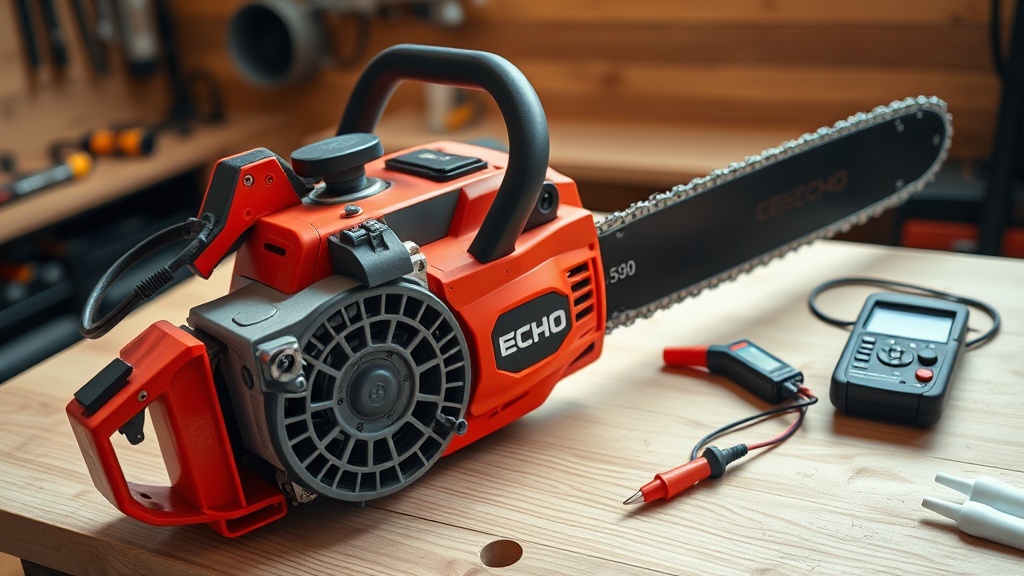
What Is the Echo CS-590 Timber Wolf Ignition Coil and Why Does It Fail?
The Echo CS-590 Timber Wolf is a robust 59.8 cc chainsaw revered by firewood cutters and landowners for its raw torque and value. But even the toughest saws hit a wall when the ignition coil begins to falter. This critical component generates the high-voltage spark that fires the plug, and without it, the saw either refuses to start, runs rough, or dies under load. In this guide, the Chainsaw Editor at SawSavvy walks through testing and replacing the ignition coil on the CS-590, using real-world troubleshooting steps that any competent owner can follow. Expect clear diagnostic checks, a practical replacement procedure, and cost data in US dollars for parts and labor.
Before diving in, understand that ignition coil issues often mimic fuel system problems. A saw that stalls after warming up or loses power when cutting may point to a failing coil, not a clogged carburetor. Knowing the difference saves time and money. This article focuses strictly on the ignition coil—its symptoms, testing methods, replacement steps, and what owners report from the field. For related starting concerns, see the Echo CS-590 Timber Wolf Cold Start Procedure: Step-by-Step guide. For broader purchasing decisions, check the Echo CS-590 Timber Wolf Buying Guide: Is It Right for You?
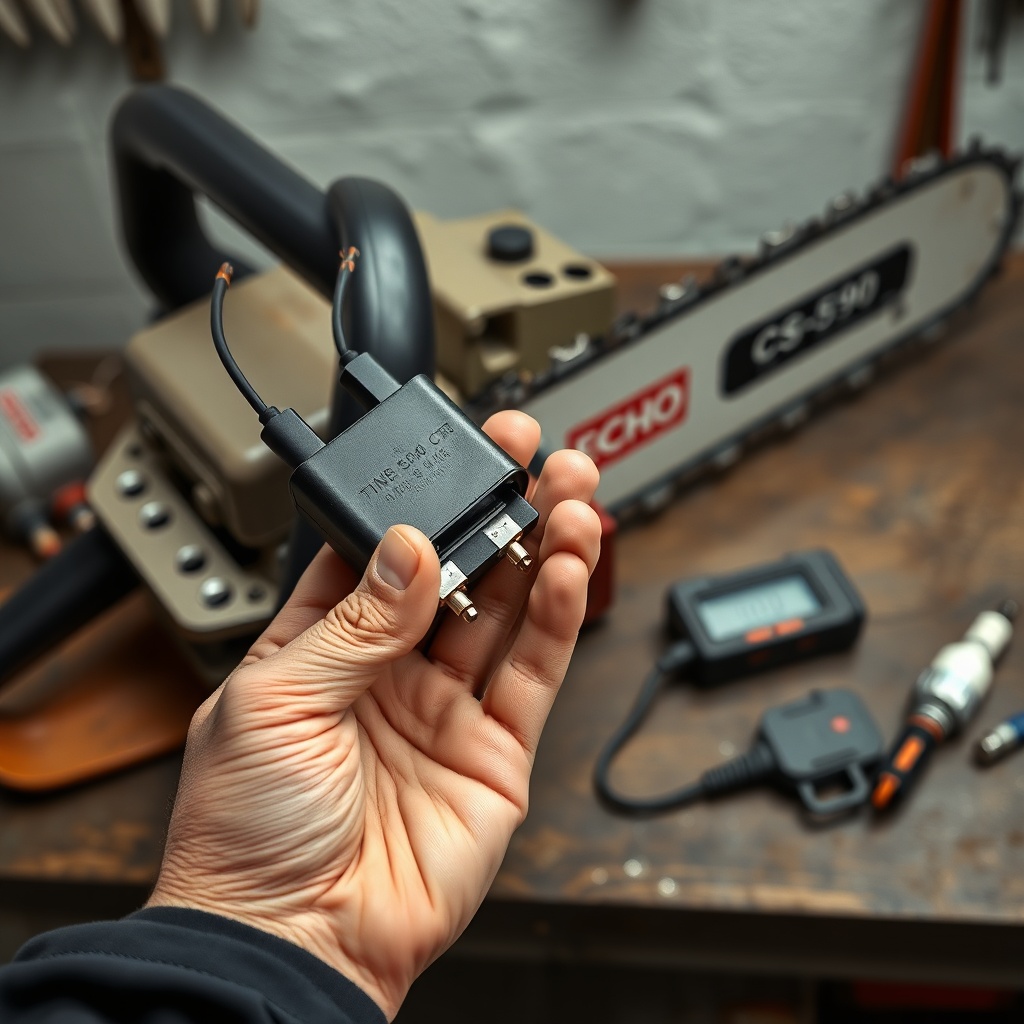
How Do I Know If the Ignition Coil on My Echo CS-590 Is Bad?
Recognizing a failing ignition coil early prevents frustration. The Echo CS-590 Timber Wolf uses a solid-state CDI (capacitor discharge ignition) system. When the coil begins to break down, symptoms appear gradually or suddenly. Here are the most common indicators:
- No spark at the plug: The saw cranks but never fires. This is the classic giveaway.
- Intermittent spark: The saw starts cold, runs for a few minutes, then dies. After cooling, it restarts but fails again under load.
- Hard starting when warm: A hot engine that refuses to fire points to coil thermal failure—internal resistance rises as temperature increases.
- Weak or yellow spark: A healthy spark is bright blue and snappy. A weak orange or yellow spark indicates insufficient voltage.
- Engine misfire or hesitation: Under heavy cutting, the saw stumbles or backfires because the coil cannot sustain consistent timing.
- Shutdown under vibration: If the saw dies only when you tilt it or rev hard, a loose or cracked coil may be losing connection.
These symptoms overlap with a faulty spark plug, bad fuel, or a failing kill switch. Always rule out the simple fixes first—new plug, fresh fuel, clean air filter—before blaming the coil. For a thorough cold-start routine that isolates electrical issues, refer to the Echo CS-590 Timber Wolf Cold Start Procedure: Step-by-Step article.
What Tools Do I Need to Test the Echo CS-590 Ignition Coil?
Testing the ignition coil on a CS-590 requires basic tools and a bit of patience. Here is the complete list, along with estimated costs for the specialized items. Most homeowners already own the hand tools.
| Tool/Item | Purpose | Estimated Cost (USD) |
|---|---|---|
| Spark plug socket (5/8-inch) + ratchet | Remove spark plug for inspection and gap check | $5–$10 (if not owned) |
| Spark plug gap tool | Verify plug gap (spec: 0.020–0.025 inch) | $3–$6 |
| In-line spark tester (adjustable gap type) | Check spark strength without grounding plug | $10–$15 |
| Multimeter with resistance range (Ohms) | Measure primary and secondary coil resistance | $15–$30 (basic model) |
| T25 Torx screwdriver | Remove recoil starter assembly screws | $5–$8 |
| 8mm socket and driver | Loosen coil mounting bolts behind flywheel | $5–$10 (if not owned) |
| Flywheel puller (optional, for deep inspection) | Remove flywheel if coil is underneath (rarely needed) | $15–$25 |
| Safety glasses and gloves | Protection from debris and sharp edges | $5–$15 |
Total specialized tool investment for a first-time tester is around $40–$60 if starting from scratch. Most local auto parts stores rent spark testers and multimeters for free with a deposit.
How Do I Test the Echo CS-590 Ignition Coil Step by Step?
Testing the coil involves two main methods: the spark test for quick verification and the multimeter resistance test for deeper diagnosis. Follow these steps carefully. Always disconnect the spark plug boot and kill switch wire before testing to avoid shock or false readings.
Method 1: Visual Spark Test (Quick Check)
- Step 1: Remove the spark plug using a 5/8-inch socket. Inspect the plug electrode for fouling or damage. Replace if worn (Echo spec: NGK BPMR8Y or equivalent).
- Step 2: Reattach the spark plug boot to the plug. Set the plug electrode against a clean metal part of the engine cylinder head (or use an in-line spark tester between boot and plug).
- Step 3: Pull the starter cord briskly 3–5 times. Watch for a bright blue spark. No spark, or a weak yellow/orange spark, points to a bad coil, bad plug, or broken wire.
- Step 4: If no spark, test with a known-good spark plug. If still none, move to the resistance test.
Method 2: Multimeter Resistance Test (Accurate Diagnosis)
- Step 1: Remove the recoil starter assembly (four T25 Torx screws). Set the flywheel shroud aside. Do not lose the small screws.
- Step 2: Locate the ignition coil mounted beside the flywheel. It has two wires: primary (usually black or black/yellow) going to the kill switch, and secondary (thick wire going to the spark plug boot).
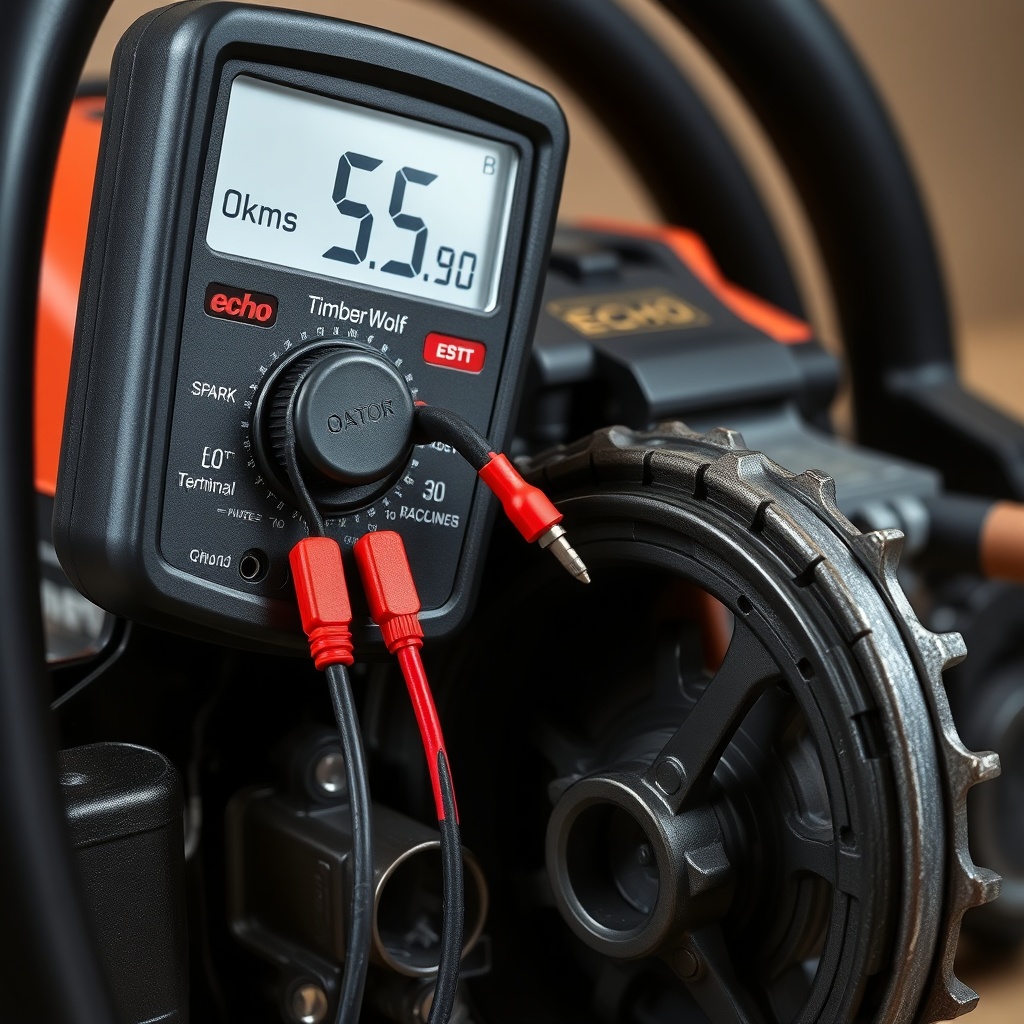
- Step 3: Set your multimeter to Ohms (Ω). Test primary resistance: Probe the small terminal (where kill wire connects) and engine ground (bare metal). Expected reading: 0.2–0.6 Ω (very low resistance). A reading of OL (open line) or above 1.0 Ω suggests coil failure.
- Step 4: Test secondary resistance: Probe the spark plug boot terminal (metal cap inside boot) and engine ground. Expected reading: 4,000–10,000 Ω (4 to 10 kΩ). Below 3,000 Ω or open line indicates internal short or broken secondary winding.
- Step 5: Compare results to Echo service manual spec: primary 0.2–0.5 Ω, secondary 5,000–8,000 Ω. Any deviation beyond 20% suggests replacement.
Note: The CS-590 coil is non-adjustable—you cannot change air gap. If gap is wrong, it must be replaced. For more on the saw’s overall performance, read the Echo CS-590 Timber Wolf vs Stihl MS 261 C-M: Which Is Best for Firewood? comparison.
How Do I Replace the Ignition Coil on an Echo CS-590 Timber Wolf?
Replacing the coil is a straightforward mechanical task requiring about 30–60 minutes. The OEM Echo coil (part number A410-000450) costs $35–$50 USD from authorized dealers. Aftermarket coils run $15–$25 but may lack the same thermal stability. Here is the step-by-step replacement procedure.
What You Need
- New ignition coil (OEM or high-quality aftermarket)
- T25 Torx screwdriver
- 8mm socket and driver
- Needle-nose pliers
- Dielectric grease for boot connection
- Torque wrench (optional, for precise bolt torque)
Step-by-Step Replacement
- Step 1: Safety: Disconnect the spark plug boot. Remove the recoil starter assembly (four T25 screws). Remove the air filter cover and air filter to access the carburetor area.
- Step 2: Expose the coil: Remove the plastic shroud covering the flywheel area (one T25 screw at the top, one 8mm bolt near the recoil base). Lift the shroud off carefully.
- Step 3: Mark the flywheel position: Use a sharpie to mark the flywheel’s alignment with the crankcase for timing reference. Although the CS-590 uses a fixed timing coil, this helps avoid confusion if you later need to pull the flywheel.
- Step 4: Unbolt the old coil: Use an 8mm socket to remove the two bolts securing the coil to the engine block. The bolts are located behind the flywheel; you may need a slim socket. Do not drop bolts into the flywheel fins.
- Step 5: Disconnect wires: Use needle-nose pliers to unplug the kill switch wire from the primary terminal (push-in connector). The secondary wire (spark plug boot) screws into the coil body or is permanently attached—depending on coil version, you may need to unscrew the boot from the coil.
- Step 6: Install new coil: Mount the new coil using the two 8mm bolts. Tighten to 4–5 ft-lb (5.4–6.8 Nm). Do not overtighten—aluminum threads strip easily. Reconnect the kill switch wire by pressing the connector firmly onto the male terminal.
- Step 7: Set air gap (if adjustable): The CS-590 coil is typically fixed; no gap adjustment is needed. If the replacement coil has movable slots, rotate the flywheel magnet away from the coil, insert a non-magnetic feeler gauge (0.008–0.012 inch or 0.20–0.30 mm) between coil and magnet, then tighten bolts.
- Step 8: Reassemble: Replace the shroud, recoil starter, air filter, and air filter cover. Reattach the spark plug boot firmly. Clean and apply dielectric grease to boot interior to prevent moisture.
- Step 9: Test: Reconnect spark plug boot. Fuel the saw, set choke, and pull start. Expect a crisp start. Verify at idle and under load.
If the saw still fails to start after replacement, check the kill switch continuity and wire harness. For oiling issues after reassembly, see the How to Adjust Oil Flow on Echo CS-590 Timber Wolf guide.
What Do Owners Say About the Echo CS-590 Ignition Coil Failures?
Browsing enthusiast forums and user reviews reveals consistent feedback. Echo’s own support indicates that coil failures on the CS-590 are relatively uncommon but not rare. Most issues appear after 2–5 years of heavy use, particularly in saws used for commercial firewood cutting. Here is a summary of owner experiences:
- Common failure pattern: Users report the saw runs perfectly for a season, then begins dying after 10 minutes of cutting. Replacing the coil resolves the symptom completely.
- Thermal stress factor: Owners in hot climates (southwestern US, Australia) note more frequent coil failures. The coil expands with heat, causing internal shorts. Echo’s OEM coil is rated for up to 200°F (93°C) but some aftermarket units fail sooner.
- Easy replacement: Many owners praise the CS-590’s accessible design. One forum user wrote: “Changed the coil in 25 minutes with only a Torx bit and a socket. No special tools needed.”
- Cost-value ratio: At $40 for an OEM coil, owners find it a fair price compared to dealer-labor rates of $100–$150 for a shop job. Several recommend buying two coils to keep as spares if running the saw commercially.
- False positives: About 20% of owners who thought they had a bad coil later found the fault was a cracked spark plug or a loose kill switch wire. Testing with a multimeter is strongly advised before buying a new coil.
- Manufacturer response: Echo has revised the coil design in later production runs (post-2018) to improve heat dissipation. New coils have a slightly different mounting foot. If ordering online, confirm compatibility with your saw’s serial number.
For those rebuilding the recoil starter after repeated pulls, the Echo CS-590 Timber Wolf Recoil Starter Replacement Guide offers a parallel repair path.
Frequently Asked Questions About the Echo CS-590 Ignition Coil
1. Can I use an aftermarket ignition coil on the Echo CS-590?
Yes, aftermarket coils are available for $15–$25 USD. However, quality varies. Some users report that aftermarket coils run hotter and fail within one season. If you need reliability for firewood production, stick with the Echo OEM coil (part A410-000450). For occasional home use, an aftermarket unit may suffice if tested at installation.
2. How do I check the coil air gap on the CS-590?
The Echo CS-590 Timber Wolf uses a fixed-coil design—no adjustment is needed. The factory-set air gap between the coil legs and flywheel magnet is 0.008–0.012 inch (0.20–0.30 mm). If you install an aftermarket coil that appears loose, use a brass feeler gauge to set the gap before fully tightening the bolts. A gap too wide causes weak spark; too tight risks rubbing the magnet.
3. What is the expected lifespan of the ignition coil?
Under normal use (5–10 hours per month), the OEM coil lasts 5–8 years. In commercial cutting (20+ hours weekly), expect 2–4 years. Environmental factors like dust, moisture, and extreme heat shorten life. Storing the saw in a clean, dry place helps prolong coil health.
4. Why does my CS-590 lose spark only when hot?
Thermal breakdown is a hallmark of a failing ignition coil. As the coil heats up, resistance increases beyond the threshold needed to generate spark. This is called “thermal runaway.” Replace the coil with an OEM unit designed for higher thermal tolerance. Also check that the cooling fins around the cylinder are clear of debris.
5. Can I bypass the kill switch to test the coil?
Yes, but only temporarily. Disconnect the kill switch wire at the coil primary terminal. If the saw then sparks, the kill switch or its wiring is shorted to ground. Reconnect the wire after testing. Never run the saw permanently without a kill switch—it is a safety hazard.
6. Is there a way to prevent coil failure on the CS-590?
Prevention is limited but effective. Keep the flywheel and coil area clean with compressed air after every 10 hours of use. Ensure the spark plug boot is tight and the boot rubber is not cracked (which allows moisture in). Avoid prolonged idling at high RPM, which overheats the coil. For oil system adjustments that affect engine load, refer to the How to Adjust Oil Flow on Echo CS-590 Timber Wolf guide.